Amazon Products


Showing posts with label microsoft. Show all posts

Wednesday, November 14, 2012

Microsoft Surface Price Related:

Microsoft Surface Price

While our favorite company from Redmond has yet to release official Microsoft Surface Price details, CEO Steve Ballmer did recently suggest that Windows Tablets will compete with the iPad.  He also suggested that the “sweet spot” for the bulk of the PC market ranges from “$300 to about $700 or $800“.  Could we see a Microsoft Surface price of $300?  I doubt an MS Surface price would be that low but it’s not out of the question for an OEM to produce such a device.  Since the price of these devices will significantly impact how well they compete in an already crowded tablet market, let’s examine the Microsoft Surface price and how it compares.

[ Also See: Microsoft Surface Pre Order Available Now! ]

Microsoft Surface Price: What we Currently Know

Microsoft originally suggested that the Microsoft Surface price for Windows RT version of the product would compare to the price of existing ARM processor-based devices.  Many believe that the Surface RT would be priced around $600.  While this price is $100 more than the Apple iPad, it’s perhaps close enough to represent an alternative to the iPad for consumers looking to buy a tablet.  I feel however that there must be a Windows 8 Tablet offering at the $500 mark in order for the platform to succeed.  We still don’t know how good Windows RT apps will be or how many will be available.  To ask consumers to spend more and possibly get less for their money (at least in the beginning) is a lot to ask in my opinion.

Microsoft also said that the Windows 8 Pro version of the MS Surface would be comparable to existing Ultrabooks.  This notion is supported by the recently released pricing information for the Acer Iconia W700 Windows 8 Tablets.  Acer is releasing three devices, they each have specs similar to Ultrabooks, and they will cost from $799 to $999.  While I would prefer to see Windows Tablets running the full version of Windows 8 to be a little cheaper, I don’t think these devices have to compete with the likes of the iPad or high end Android Tablets.  Instead, I think consumers in the market for other PCs such as Ultrabooks and conventional laptops may consider Windows 8 Tablets.  Considering that a Windows 8 Tablet can do everything an iPad can do and much more, it’s reasonable to expect these devices to cost more.

Microsoft Surface vs the iPad, Kindle Fire, other Android tablets

Ballmer told the Seattle Times he expects the Microsoft Surface to compete with the Apple iPad.  He said that he thinks the MS Surface will be very competitive product from the features perspective.  I have to wonder though if he thinks all Windows Tablets will compete with the iPad or just the Windows RT versions.  Ballmer also seem to suggest that the MS Surface will not attempt to compete with the Kindle Fire and similar, less expensive Android Tablets.  From Baller:

If you say to somebody, would you use one of the 7-inch tablets, would somebody ever use a Kindle (Kindle Fire, $199) to do their homework? The answer is no; you never would. It’s just not a good enough product. It doesn’t mean you might not read a book on it….

Considering that  the Apple iPad out sells all other tablets 2 to 1, including all of the cheap Android Tablets, I think consumers agree with Ballmer.  The perception might be that if you spend a little bit more, you get a significantly better device that has more capabilities.  If this sentiment is while the iPad beats cheaper alternatives 2 to 1, perhaps this sentiment will allow Windows 8 Tablets such as the Microsoft Surface to challenge (and even beat?!?!?) the iPad.

Continue Reading…

Related posts:

  1. Microsoft Surface vs iPad: Advantages and Disadvantages
  2. Acer Iconia W700 Windows 8 Tablet Specs, Price, Pre-Order, and Shipping Details
  3. Microsoft Surface Price Details

About the Author

Quentin Moore

Quentin Moore is Senior Editor of Windows Tablet TV. He's a self proclaimed Tech Guru and spends most of his non-working hours playing with or blogging about tech gadgets. Check out Quentin's Google Plus Page.
More articles by Quentin Moore »


Source : windowstablettv[dot]com

Microsoft Surface RT Gets Updated to Improve Performance and Correct a Lot of Issues

Since the official launch over a week ago the Microsoft Surface RT is considered to be a success among the available offers featuring the new Windows OS. Even though it’s not a fully-fledged Windows device and the offer of available apps is rather low, the tablet has plenty to offer and it’s a great multi-purpose device.

Surface-RT-for-Windows-8

For the Surface RT, Microsoft has released an update to bring improvements in some key areas. According to preliminary reports from users, the update is a very welcome addition, making the tablet even more attractive. Like with the update system on PC’s, it addresses the issues through separate files, four to be exact. One corrects the issue with the “Favorites” not showing up in Internet Explorer 10. Another enables WinRE using the out-of-the-box wizard in Windows 8/Server 2012, including a digital signature in Windows 8/Server 2012, and a Windows 8/Server 2012 cumulative update.

There is also an issue with the Boot Configuration Data store that is included in the list of fixes. Following, there is the added ability to customize the lock screen and a fix for the problem that can cause Apps to be installed incorrectly. Performance upon waking the device and when the device is asleep has also been improved leading to extra battery life. Most users report that the overall performance has seen some changes for better and Internet Explorer seems more responsive when loading pages. It would seem Microsoft has done a very good job.

Related posts:

  1. Microsoft Surface RT Tablet to be Priced at Just $199?!
  2. Microsoft Surface 2 Tablets Already in Development?
  3. Microsoft to Improve Its Tablet Development to Rival Apple; HP Cooperation Coming, Too


Source : androidtabletblog[dot]com

New iPad Beats Surface RT Display

Remember that story saying that the Microsoft Surface RT actually uses some cool new technologies that make its display better than the one of the iPad 3? Well, part of it is true and part isn’t! Analysts at DisplayMate recently published a display battle between the Surface RT and the Retina Display iPad, the iPad 2 and the Samsung Galaxy Tab 10.

The test was conducted by Raymond Soneira, who reached the conclusion that the Surface slate is great, in some areas at least. For example on screen text is sharper and there’s an improved factory display calibration compared to the other models. Also, the reflectance is lower than the iPad 2 and other full size Android 1280 x 800 tablets. However, the screen is not as sharp as the Retina on the iPad 3 or 4 and the Microsoft product doesn’t offer the same large full color gamut.

AppleInsider is also reporting that a Microsoft engineer has claimed that the Surface screen beats the iPad’s Retina, in spite of the lower resolution. The idea is that the ClearType screen on the Surface maximizes “perceived resolution”, with reduced reflections. It’s true that the Retina Display reflects 33% more ambient light than the Surface RT, while the Galaxy Tab 10.1 reflects 41%, but that’s not enough. Surface RT loses points in the color gamut reproduction, that’s 57% smaller than the iPad 3.

Related posts:

  1. Microsoft Analysis Claims that the Surface Display Res is Actually Better Than the iPad 3 Resolution
  2. iPad 3 Confirmed to Feature Retina Display, According to LG Display CEO
  3. iPad 3 With Retina Display Will Be 8% Thicker Than the iPad 2, Accompanied by iPhone 5 With 4 Inch Display


Source : androidtabletblog[dot]com

Wednesday, November 7, 2012

Microsoft Office for Android will require Office 365 subscription

If you’ve been patiently awaiting the arrival of Microsoft Office for Android, you’re not alone — we’re curious to see how Microsoft treats its Office suite on competing platforms. While we’ve known about its early 2013 launch since, well, almost forever, The Verge’s news that it’s coming in the first quarter of the year is nothing shocking or surprising.

The outlet did get a few details on how things would be carried out from a licensing standpoint, though. According to its sources, Microsoft Office for Android (and iOS, we imagine) will require an Office 365 subscription to get the most out of the suite of tools. With it, you’ll be able to both view and edit documents on the go.

For those just wanting to view documents you do need a Microsoft account but those are free and easy enough to sign up for. We’re told not to expect nearly the same deep level of editing that you can get on the desktop suites, and that’s fine — we weren’t expecting much to begin with.

But you have to wonder whether or not the official suite will be enough to make current third party options seem useless. I got a full editing suite from a Google Play Store sale for $.25, and it does just fine for me.

Even at the typical prices of $10 and $15 we usually see these apps go for, that’s a one time fee. We’re not sure if Microsoft is planning to introduce a new tier for its mobile apps, but for comparison purposes the current cheapest plan costs $4 per month, which amounts to $48 per year.

We won’t know what, exactly, the software giant will end up doing until we inch closer to that Q1 2013, but these early details aren’t leaving the best taste in my mouth. Anyone else not feeling the love from Microsoft or are you just happy to see that the company is supporting Android at all?


Source : androidtabletblog[dot]com

Windows 8 Tablets To Get to 39% Market Share in Business Segment by 2016, Says Gartner

Research firm Gartner released a report this week showing that Microsoft has good odds at conquering the business market with Windows 8 devices. They predicted that 821 million smart devices, including smartphones and tablet will be purchased worldwide this year and the billion mark will be reached in 2013.

Windows 8 will be positioned in third place in the tablet market behind Apple and Android by 2016, as far as business segment goes, according to Gartner. Tablets and convertibles will be their way of taking over a portion of preferences, especially when it comes to companies and less with consumers. Estimations show a business market share of 39% 4 years from now for Win 8, which is quite big, making us wonder what shares Android and iOS will get at that time.

Frankly speaking, I’d see Android dropping to third place, since I can’t imagine companies preferring Android over Windows 8 or iOS, for its shabby security and lack of tablet optimized apps. Even business software and the likes are not that present or well adapted to Android. So, what do you think? Will Win 8 beat Android in the end?

Related posts:

  1. Dell Preparing Windows 8 Tablet for Business Segment
  2. Upcoming Intel Tablets Could Conquer the Enterprise Segment, Eating up PlayBook, iPad Market Share
  3. Hanvon and Microsoft to Develop Business Tablets


Source : androidtabletblog[dot]com

Tuesday, November 6, 2012

Hands-on with Microsoft’s Surface tablet, part 1

Like many readers, I got my start with computing at the hands of Microsoft, when my father brought home a mysterious beige box in the late 1980s; it was an IBM 8088 clone, the monochrome green “consciousness” of the machine powered by a mysterious entity known as MS-DOS. I remember the feeling of awe as Windows 3.0 first started, after what seemed like an interminable afternoon shuffling 3.5″ disks out of our PC, and my first coding triumphs in innovative languages like Pascal, BASIC, and VBA.

Along with these high points in my computing career, Microsoft was also there for frustrations — broken DLLs, blue screens, seemingly boneheaded and botched product launches, BOB, palm-sized PC/Pocket PC/Windows Mobile, and even its pioneering (yet never commercially successful) foray into tablet computing.

Automatically sign up for our Tablets in the Enterprise newsletter!

With all this history and mental baggage, I bought a Surface tablet. This will either be Microsoft’s comeback in the mobile space or yet another multi-billion dollar, half-baked product.

A new beginning for Microsoft

I’ve previously written that Surface represents a major gamble for Microsoft. Windows 8 is a dramatic departure from the Windows desktop meme that’s been with us for decades, but it tries to maintain a link to the past with a “throwback” mode that returns the user to a more traditional desktop. With Surface, in particular, the device and OS can’t really be considered separately. I’m reviewing it as a complete product, especially since Microsoft has created everything from the base OS, hardware, and Office suite, which potentially sets this device apart from the rest of the non-Windows pack.

How I’m reviewing Surface

I purchased a Surface tablet on my own dime, with the aim of using it in a professional capacity. As a highly mobile consultant and writer, I’m always looking for devices that provide maximum productivity with minimal additional weight. Rather than analyzing technical features like screen resolution and processor speeds, I hope to answer the question of whether Surface represents a legitimate and sustainable tool for a mobile knowledge worker. Also, while Apple’s iPad is the obvious competition to this device in the enterprise and larger market, I’ll reserve iPad comparisons for a separate article.

Surface hardware

There are excellent and extremely detailed reviews of the physical characteristics of the Surface tablet, so I won’t belabor those efforts. Instead, I’ll focus on the qualitative rather than the quantitative aspects of the Surface hardware. Inside the unassuming shipping box, Surface is packaged in a reasonably attractive and business-like box. The packaging isn’t amazing or cheap, and there’s minimal wasted space — so stacking dozens of Surface tablets in an IT cabinet somewhere for distribution or spares will be easy.

The tablet itself is exceptionally executed, with a somber black design that’s well-assembled and solid. There’s no flexing, creaks, or cheap-feeling materials. It’s $499 (USD) entry price is kind of pricey, but the device feels like it’s worth the price of admission before you even turn it on. Microsoft has certainly matched its main competitors on industrial design, and it also brings a uniquely somber approach to the party. For its debut hardware effort, Microsoft seems to have knocked this one out of the park.

This device isn’t exceptionally light, but the long, thin design makes it fairly easy to pack. It has the usual complement of speakers, headphone jacks, and cameras — plus there’s a standard USB port and micro-HDMI connector, which allows you to connect mice, memory sticks, large monitors, and projectors without a special cable. There’s also a micro SDXC port hidden under the device’s kickstand for memory expansion.

The only unfortunate item on the connectivity front is a proprietary power adapter that uses a slightly under-strength magnet to attach to the tablet. The lack of magnetism and somewhat awkward shape and positioning are forgivable, but the cord is fused directly to the small power “brick.” This means that you’ll have one more charger to schlep around and potentially lose, rather than a cable with a USB connector on the end that’s lighter to pack and easier to stash in the car, briefcase, home, and office. On the upside, the charger recharges the battery in a couple of hours and is fairly small.

The kickstand and keyboard

Prominent in the initial bout of advertising for Surface is the keyboard cover and “kickstand” that props the device up. Having used several tablet keyboards, I’ve always been somewhat nonplussed by them, because it’s frustrating to write anything more than an email or short blog post. I thought the Surface “Touch Cover” keyboard would be of limited use, strongly favoring portability over usability. However,I was pleasantly surprised to discover this preconceived notion was wrong.

First off, the Surface keyboard seems to have been designed by someone who actually creates written text with their computing device. Critical keys like Home, End, Page Up, and Page Down are front and center, without requiring any multi-key gymnastics. Critical keys like the Space Bar, Backspace, and Shift also seem well designed. My hands are blunt instruments that would not look out of place on a large primate, but they navigated the keyboard with ease, and I was moving at a good clip a couple of paragraphs into this review.

The only difficulty I’ve had with the keyboard is that it’s difficult to gauge the amount of pressure required to activate a key. I find myself cycling from mashing each key to gradually reducing pressure until I start missing letters, then returning to hammering — something that’s sure to fade over time. Even the touchpad works well. It supports two-finger scrolling and is positioned so that there’s little risk of moving the mouse while typing, which is something I frequently struggle with on my laptop.

With the surprisingly capable keyboard, plus the kickstand anchoring the display on a hard surface, it’s easy to forget you’re not working on a standard laptop when you’re pounding away in Word or Excel. Should you need to move or wrap up your work, it’s rather satisfying to slap down the kickstand and fold up the keyboard, a task that can be completed in a single, fluid movement — as if you’re gathering a stack of papers. When you’re ready to resume working in “laptop mode,” it’s similarly easy to fold out the kickstand and pop open the keyboard cover, and you’re right where you left off in less than a second.

The solid kickstand and keyboarding experience falls apart a bit when used on a soft surface like your lap, particularly in bed. While it’s unlikely I’ll write much beyond a few paragraphs in bed before turning in for the night, occasional nocturnal bouts of inspiration have me reaching for a standard laptop rather than Surface, since it’s difficult to support the kickstand on your legs, and the keyboard tilts and shifts without a hard surface to support it.

Winning the hardware battle…

Clearly, Microsoft has come out swinging on the hardware front with Surface. It’s an attractive and well-made device, and it should be perfect for travel. I intend to put Surface through the travel wringer in a future installment. Surface works reasonably well as a tablet and transforms into a capable laptop-like mode, all in an extremely lightweight package.

Excellent hardware, however, is only one element in a successful tablet. In the next installment, I’ll discuss actually getting work done with the Windows RT OS that puts the brains in Surface’s appealing exterior.


Source : techrepublic[dot]com

Microsoft Surface Pro Gets Priced in Germany, Goes for Almost $1000

If you’re looking to buy the Microsoft Surface tablet, but you want the added extra value of the Intel CPU and the Pro version of Windows 8, you will pay a premium price tag for those. And especially if you live in Germany, where the following prices apply…

A recent leak has shown us that the Surface Pro tablet will go for almost $1000, as published by German online retailer Notebook.de. The x86 Windows 8 Surface Pro tablet goes for $870 in the 64 GB version without tax, while the 128 GB model costs $975. For that price you get a Full HD screen, Intel Core i5 CPU, 4 GB of RAM, Intel HD 4000 graphics, Bluetooth 4.0, VaporMG case and even a stylus on board. 2 years of warranty are available here.

The product weighs almost 1 kilo, so it’s not on the light side… at all. Notebook.de is saying that the tablets will be available in about 3-4 weeks, which we doubt, since everyone expect Windows 8 Surface slates to debut in January next year. An early arrival would make for a sweet Christmas gift, though.

Related posts:

  1. Microsoft Surface Tablets Outsourced to Pegatron; Priced Above $599 Apparently
  2. Microsoft Surface RT Tablet to be Priced at Just $199?!
  3. Microsoft Windows Surface Pricing Revealed by Swedish Retailer


Source : androidtabletblog[dot]com

Friday, November 2, 2012

Microsoft Surface RT is an Overhyped Product: Analysis of a Rant (Video)

The folks of Techcrunch posted an interesting rant on how overhyped the whole Microsoft Surface RT thing is and we decided to analyse their arguments. First, they claim that Microsoft rushed to the market with a product that doesn’t feel quite complete. They do find Windows 8 to be a solid OS and a great step forward, but that’s about it…

The unification of Windows Phone and Windows Phone is already embraced and the future will ease the process, as the public gets used to the common experience. Techcrunch also claims that Microsoft, in its usual fashion launched its worst product first. The thing is that all reviewers out there are out to get Windows RT and criticize it, especially for being slow and not totally taking advantage of the provided hardware. Microsoft is a bit to blame for this, since they created huge expectations around the product and the hype was killed by the wave of negative reviews.

We actually did a positive review for Windows RT, highlighting what’s positive about it and the potential it leaves open for the future. It’s true that the OS feels rather “green” and young, but we are dealing with a desktop OS morphed for mobile use, so what did you expect? Apple and Google came out with a totally new platform for mobile, while Microsoft has to turn something that feels old into something new, that’s infinitely harder than inventing something new… So what’s your take on Windows RT and the Surface, loved more for its hardware and design than anything else?

Related posts:

  1. Microsoft Analysis Claims that the Surface Display Res is Actually Better Than the iPad 3 Resolution
  2. Watch the Entire Microsoft Surface Keynote Here! (Video)
  3. Microsoft Surface 2 Tablets Already in Development?


Source : androidtabletblog[dot]com

Microsoft Surface RT is an Overhyped Product: Analysis of a Rant

The folks of Techcrunch posted an interesting rant on how overhyped the whole Microsoft Surface RT thing is and we decided to analyse their arguments. First, they claim that Microsoft rushed to the market with a product that doesn’t feel quite complete. They do find Windows 8 to be a solid OS and a great step forward, but that’s about it…

The unification of Windows Phone and Windows Phone is already embraced and the future will ease the process, as the public gets used to the common experience. Techcrunch also claims that Microsoft, in its usual fashion launched its worst product first. The thing is that all reviewers out there are out to get Windows RT and criticize it, especially for being slow and not totally taking advantage of the provided hardware. Microsoft is a bit to blame for this, since they created huge expectations around the product and the hype was killed by the wave of negative reviews.

We actually did a positive review for Windows RT, highlighting what’s positive about it and the potential it leaves open for the future. It’s true that the OS feels rather “green” and young, but we are dealing with a desktop OS morphed for mobile use, so what did you expect? Apple and Google came out with a totally new platform for mobile, while Microsoft has to turn something that feels old into something new, that’s infinitely harder than inventing something new… So what’s your take on Windows RT and the Surface, loved more for its hardware and design than anything else?

Related posts:

  1. Microsoft Analysis Claims that the Surface Display Res is Actually Better Than the iPad 3 Resolution
  2. Microsoft Surface 2 Tablets Already in Development?
  3. Microsoft Surface Tablets Outsourced to Pegatron; Priced Above $599 Apparently


Source : androidtabletblog[dot]com

Monday, October 29, 2012

Five things that Windows 8 ultrabook tablets need to deliver

Windows 8-based ultrabook tablets have an opportunity to slow or reverse the erosion of the PC market caused by the mobile OS revolution in consumer computing. But if Microsoft doesn’t get it right, Windows 8 may become another embarrassing Windows Vista or ME for Redmond’s struggling software giant. Here are five things Microsoft should focus on and buyers should look for.

Automatically sign up for our Tablets in the Enterprise newsletter!

1: Mobile apps

If Windows 8 doesn’t match the app libraries of Android and iOS, especially on the most popular and desired titles available on those platforms, people will be disappointed with the overall experience. We’ve already seen that effect with the disappointing adoption of Windows Phone 7. It isn’t that WP7 is a bad platform — in fact, it consistently reviews well with tech bloggers — it just doesn’t have a compelling app library, and WP7 apps are relatively more expensive than Android and iOS versions. Microsoft can’t afford to have apps priced higher on their platform than on the competitors’ markets.

2: Hardware standards that support app features

Google somehow managed to get all device manufacturers on board with a certain list of base reference features for handsets (and to a lesser degree, tablets) necessary to make a viable product. Apple simply doesn’t have to worry about this, because they control their whole show. Features like accelerometers for gaming, GPS for location-aware applications (weather widgets and local attractions), and cameras for barcode and tag scanning are vital.

It’s unclear yet if there’s a consensus among hardware manufactures on what will be considered “basic” features to support the widest range of Windows 8 apps. A fractured hardware environment is going to cause devices with high-end features to be ignored by developers. This leads to less rewarding application experiences for the sake of reaching a larger market share of Windows 8 devices. That could be a disaster if apps for Win8 seem lacking compared to the same apps on mobile devices.

3: Leisure computing

We know Microsoft wants the enterprise, and I think that this is a given if Windows 8 is a success. Businesses will replace aging PCs with new hardware, and increasingly, those replacements will be tablet-convertible hybrid PCs, as traditional PCs become dinosaurs. We’ll see executives embrace these machines first, then middle managers, and eventually the regular workforce. Business users won’t be as concerned about the leisure features like gaming, social media, music, movies, and entertainment.

However, Apple has proven that massive consumer sales lie in appealing to leisure computing desires. Microsoft has shied away from combining the two in the past. For example, they wanted Windows Mobile PDAs to be seen as “executive enterprise devices” and discouraged leisure applications. That mistake may have cost Microsoft an early lead in smartphones. We’ll see if Microsoft has learned their lesson.

4:  Performance

Mobile devices have changed consumer expectations on acceptable runtime and standby time. Using a device on a coast-to-coast flight to work and watch movies and arriving with juice left over to catch up on social media and email before going to bed is normal now. Being able to instantly power on and load an app to capture an idea is mandatory. If consumers find these devices letting them down on battery or slow startup or app load times, Windows 8 will find itself rejected by the market.

5: Backwards compatibility with the traditional PC experience

The promise of the Windows 8 ultrabook convertible is to deliver all of the benefits of modern mobile OS platforms with all of the benefits of the traditional Intel PC computing experience. If Windows 8 arrives with significant challenges that make backwards compatibility problematic, users won’t buy in. The success of Windows 8 and ultrabook convertibles are dependent on one another. The OS platform doesn’t make sense without the hardware format, and the hardware format doesn’t make sense without the OS platform. Together, if they work well, they’re worth a premium, because they can consolidate a lot of different equipment into one device. If they don’t, there are already better solutions available today that cost less.

I think the Windows 8 ultrabook convertible notebook/tablets are a promising platform that could revitalize the diminishing relevance of Microsoft, Intel, and their hardware vendors — if implemented correctly. I think the formula must be carefully balanced to be successful. I have my concerns that Microsoft, Intel, and their vendors haven’t been paying close enough attention to the points on which they have been losing for the past several years. They’ve got the right direction, now we just need to see if they have the resolve to deliver a successful alternative.

What else do you think Windows 8 ultrabook tablets need to be a success? Share your thoughts in the discussion thread below.

Read also


Source : techrepublic[dot]com

Saturday, October 27, 2012

First impressions: Xbox SmartGlass for Android (Update)


Today is a good day for Xbox users with an Android smartphone. Microsoft has finally released the Xbox SmartGlass Android app, and we have been playing around with it for a bit. SmartGlass promises a second screen to use with the Xbox 360, much like the WiiU and its gamepad.

As the feature develops, one will be able to access secondary menus and options with a smartphone or tablet, without interrupting your game or media. During Microsoft’s demo, a tablet was able to access information about the battlefield while watching video of a war in the popular series Game of Thrones. That level of interactivity definitely seems like a step forward as we approach a new era in video gaming.

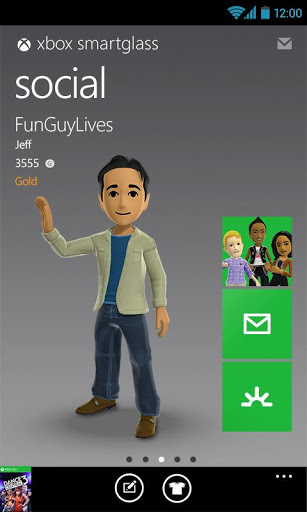
The app doubles as a SmartGlass and Xbox Live app. One has access to messages, friends, currently-played games/apps and even featured content. On the SmartGlass side, one is able to use an Android device as a form of remote control for the Xbox 360. You can easily navigate around the dashboard, and open any games or apps of your choice; all by sliding and tapping your finger on the navigation screen (reminds me of a mouse app for Android and PC).

The new app has its good and bad sides, so let’s just jump in and see what we have.

The Good

Xbox SmartGlass has all those features we are salivating over (even if not perfect yet), but there is more to it. Xbox 360 junkies will be able to have a central app, allowing them to access Xbox Live content on-the-go. I have been using it to read and send messages, look for new games and search for apps. If you are interested in any of the content found on the device, you can go ahead and pull it out on your Xbox by simply tapping a button. One can purchase it from there.

Likewise, there are other shortcuts and features that are very helpful. Everything from being able to search and access content to enjoying Play, Rewind and Forward shortcuts appearing under the navigation screen when playing a movie on Netflix.

The Bad

Because it is made by Microsoft, it’s to be expected that Windows Phone will get the better end of the stick. Certainly, the app is good, but it feels like it is not fully developed, but it could also be an issue of SmartGlass, itself. With that said, there are some faults we wish to see improved in the near future.

For one, the Dashboard navigation screen is a bit laggy. We must consider the device communicates with the Xbox via internet, so that should definitely make it a bit slower. The interface is also a designed oddly. It seems like a pressed down Xbox 360 interface instead of an Android app. It is a form of mix between the Xbox UI and the Windows Phone Metro UI, which makes it feel very out-of-place.

All aesthetics aside, the app does need some functional improvements. It is quite annoying to see that even when the app is left open, it has to sign back in if the screen goes to sleep and you turn the device back on. If you hit the home button and re-open the app, it has to sign in again. Pretty much, it seems to lose connection with your Xbox every time you leave the app. It could be a battery-saving “feature,” but it would be nice to have the option to keep a stable connection.

Another noticeable issue is that the navigation screen is not very helpful when using it to control the pointer (with the browser, for example). Navigation works perfectly for the Dashboard and apps as the Metro UI lets you jump to categories and tiles one by one. It gets very hectic when you are trying to use the pointer, though. The SmartGlass navigation screen is no use, the pointer moves like a millimeter per full swype. It is simply unusable, so you might as well pick up your controller and use that.

For some reason, I have also not been able to use the keyboard, even though there is a shortcut for it. I just can’t pull it up, whether it is in the browser, the Search Box or within an app.

Verdict

As you can see, the app has more downsides than I expected. Over all, it works for what it is intended for, but Microsoft has a lot of work to do. We need a bit smoother navigation, better shortcuts and a working keyboard. Not to mention full compatibility with at least all native apps.

I have not tried the Windows Phone app yet, but I sincerely hope it is better than the Android one. Ultimately, SmartGlass has huge potential. Let’s hope it evolves into all that Microsoft promised and other developers make great features for it.

I have been here breaking my head over it, thinking maybe I was doing something wrong. If you have been using SmartGlass and have found these (or more) issues, please let us know! If not, you can go ahead and download it straight from the Google Play Store. As for me, I will start using it more once it becomes more integrated and seamless.

CAM00062 CAM00064 smartglass smartglass-1 smartglass-2 smartglass-3 smartglass-4

Update

The slow pointer and keyboard issues were fixed after connecting my Android smartphone to the same WiFi connection as the Xbox. I happen to prefer using Verizon’s 4G LTE, so I almost never connect my device to my home WiFi.

I definitely apologize for this misunderstanding, but that brings another issue. The app certainly connects to my Xbox and does other things when not on the same network. Why not make these features available regardless of how the device connects to the internet?

Thanks, ego!


Source : androidtabletblog[dot]com

Sponsored Links

Amazon Products